3D-Printed Medical Scaffolds
A tissue-engineering scaffold is a porous structure that gives cells a place to attach and grow while new tissue forms and the scaffold slowly biodegrades. Our team designed, 3D-printed, and simulated scaffolds aimed at maxillofacial (jaw) reconstruction, where the part has to survive real bite loads while staying open enough for tissue to grow through it.
My contribution: fabrication and manufacturing design, and the material and parameter studies behind the printed geometries.
A good scaffold has to balance two things that fight each other: it needs high, interconnected porosity so cells and nutrients can move through it, but it also has to be mechanically stable under load. For a jaw scaffold that means surviving average human bite pressure, roughly 160 to 200 psi, without collapsing or deforming past a usable limit.
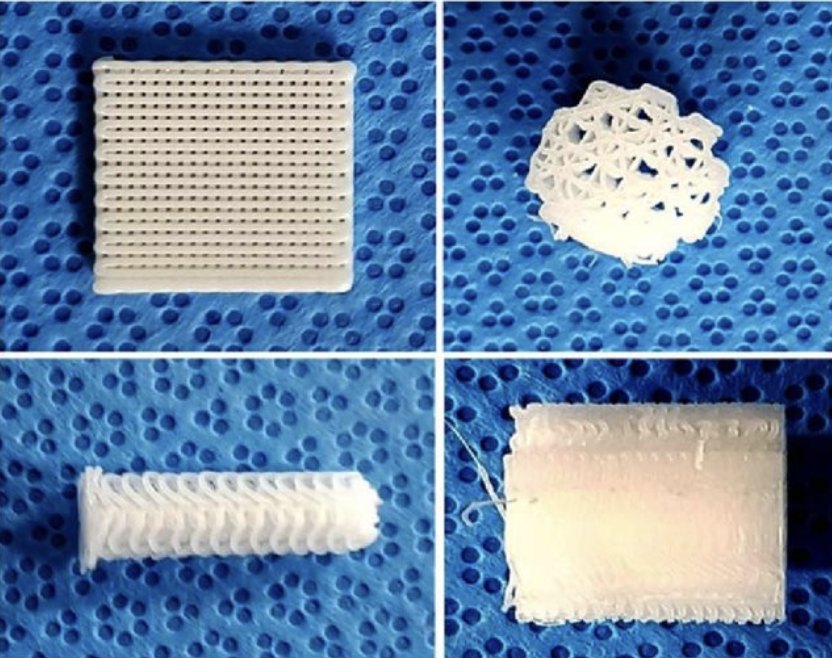
I focused on how the scaffolds would actually be built. We designed four geometries spanning the useful porosity range and printed them to compare: a rectangular lattice (60 to 70% porous), a spherical lattice (70 to 80%, the most open), a cylindrical structure (40 to 50%), and a near-solid block (under 10%). Across the study we weighed five materials for their strength, biocompatibility, and printability, from biodegradable polymers to load-bearing metal.
| Material | Young's modulus | Role in the design |
|---|---|---|
| PCL | 0.5–0.7 GPa | Flexible, slow-degrading; gentle on cells |
| PLA | 3.5–4.5 GPa | Printable, biodegradable workhorse (our test material) |
| HA (hydroxyapatite) | 0.1–0.5 GPa | Bone-like, osteoconductive |
| CFRP | 70–150 GPa | High strength-to-weight for load-bearing |
| Ti-6Al-4V | 110–120 GPa | Strong, corrosion-resistant implant metal |
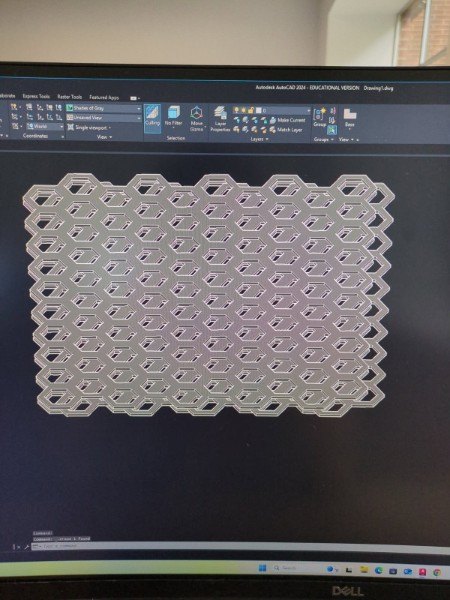
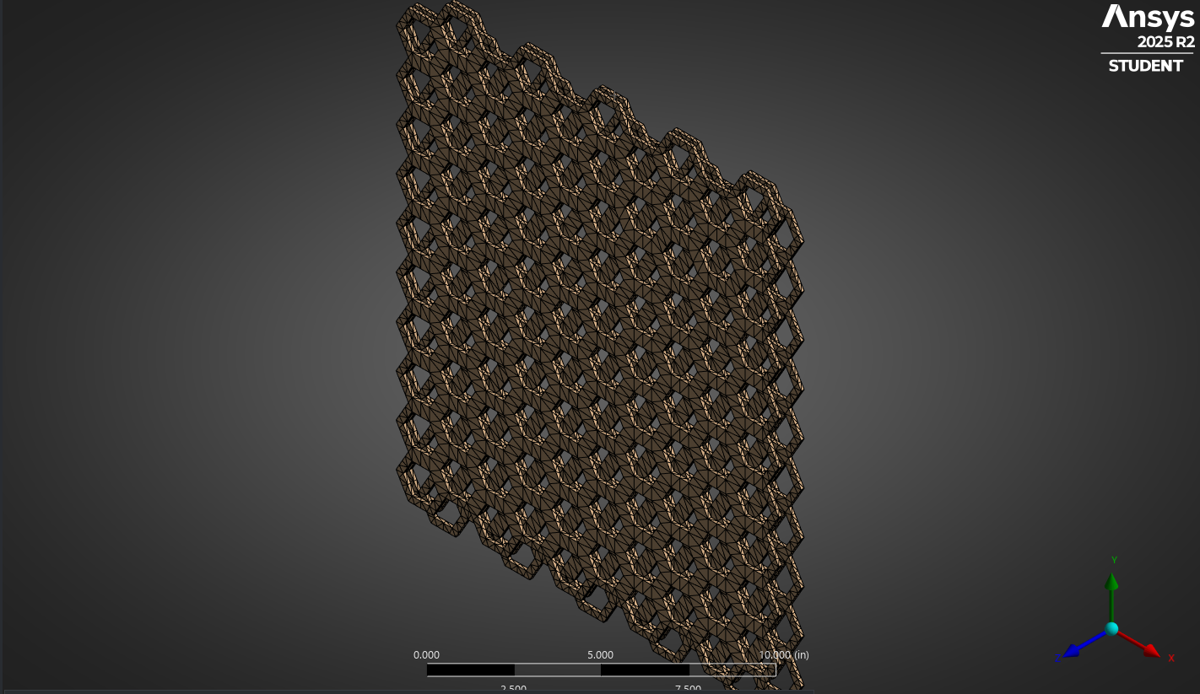
We evaluated the printed lattice in Ansys as a static structural problem: the sides were fixed, a bite-pressure load was applied to the contact faces, and the mesh was refined to convergence. The outputs we cared about were maximum deformation and von Mises stress, with special attention to the strut junctions where stress tends to concentrate.
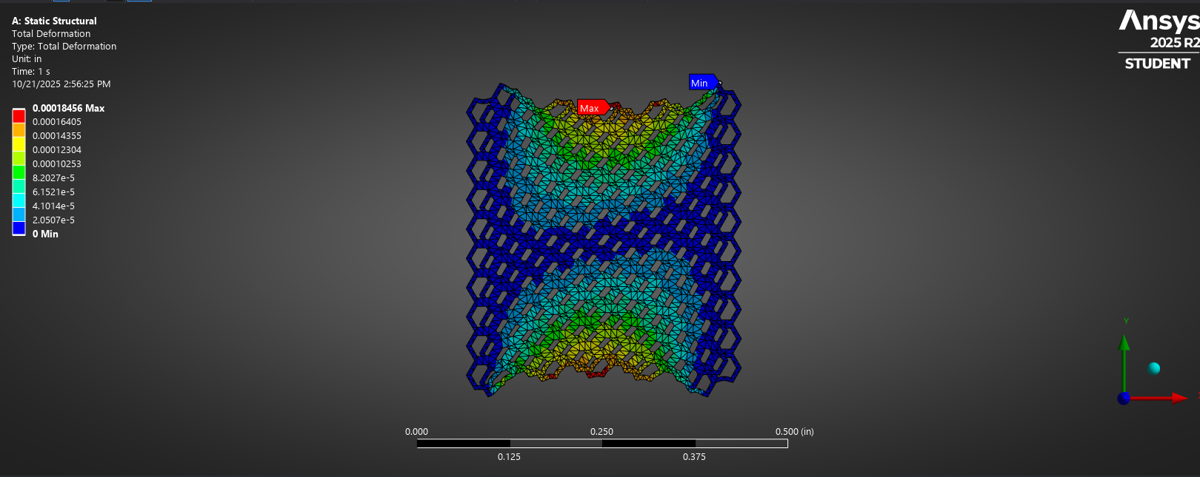
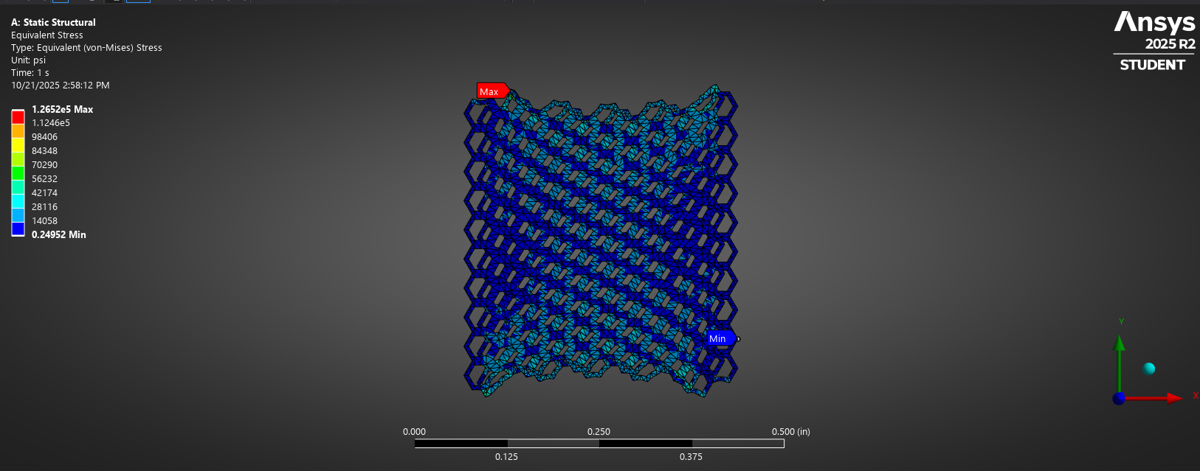
The lattice was extremely stiff: under a full bite load it barely moved, deforming less than two ten-thousandths of an inch. That is the good news, because in practice the scaffold shares the load with the tissue growing through it rather than carrying it alone. The catch is that peak stress at the strut junctions ran well above the strength of a printable polymer like PLA, so a pure-PLA part would risk cracking at the nodes. The fix is a fabrication problem, and it is where the next print goes: thicken the struts, trim porosity locally around the junctions, or move to a stronger material. Hold every other setting and boundary condition constant, change only the node geometry, and re-run to compare.
This was a clean lesson in design for manufacturing: the geometry that prints well and the geometry that survives load are not always the same, and the strut junctions are where those two pressures meet. It is the fabrication thinking I carry into my own 3D-printing work.
Team: Evan Sagatovski · Quinn Rodier · Randal Richards · Michael Clifford · John Grant Campbell · Luke Edwards · Daniel Nelson